

At first glance, this may seem like yet another strategic document that only needs to be mentioned in a few sentences in the application. However, in certain funding schemes, alignment with S3 plays a more important role: it may determine which development areas are eligible for support, during which application stage a project may be submitted, or even whether the project meets the policy objectives of the call at all.
What is S3?
The Smart Specialisation Strategy (S3) is a policy instrument designed to ensure that public and EU development resources are not fragmented across too many unrelated areas, but are instead concentrated on fields where a country or region can build on its existing strengths, knowledge and economic potential to create a competitive advantage.
Hungary's current National Smart Specialisation Strategy for 2021-2027 was adopted by the Government in 2021. The importance of S3 is not limited to the national level: its existence, proper implementation, monitoring and evaluation constitute an enabling condition linked to the use of certain EU funds.
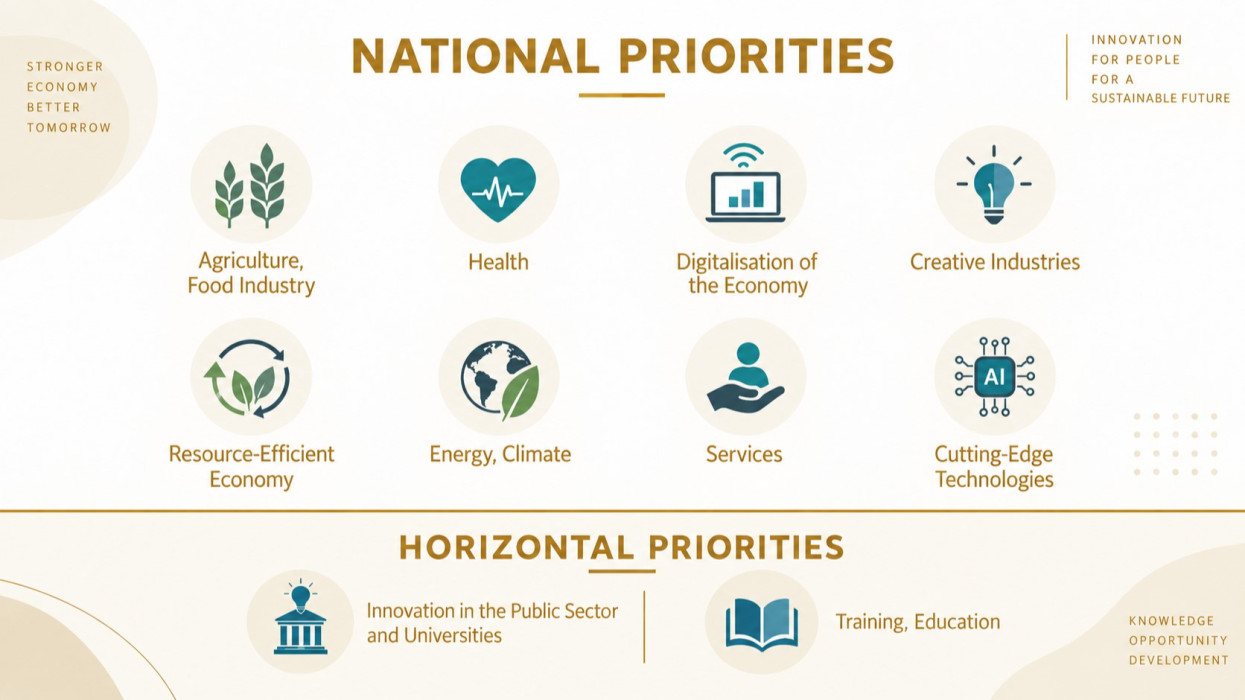
The Hungarian strategy identifies eight national economic priorities:
- frontier technologies,
- health,
- digitalisation of the economy,
- energy and climate,
- services,
- resource-efficient economy,
- agriculture and the food industry,
- creative industries.
In addition, two horizontal priorities support the development of the areas of specialisation:
- training and education, and
- innovation in the public sector and universities.
What does S3 mean in the context of a specific funding call?
S3 does not in itself provide general eligibility for funding. The specific call for proposals always determines the role played by alignment with the strategy. It may be an eligibility condition, it may define the focus areas that can receive support, or, in certain schemes, it may also appear as a criterion in the evaluation process or in the allocation of available funding.
This can be clearly seen in the GINOP Plusz-2.1.1-24 - Support for Focus Area Innovation Projects call. The scheme allocated separate funding to developments related to health, the green and circular transition, and the digital transition, while excellence projects aligned with other objectives and priorities of S3 were included in a separate application stage. In other words, S3 was not merely a background strategy in this case: it directly influenced the structure of the funding scheme and the classification of projects.
How should alignment with S3 be presented?
From an applicant's perspective, simply stating that "the project is aligned with the digitalisation of the economy priority" is generally not sufficient. Instead, the alignment should be demonstrated on the basis of the project's actual professional and technical content.
At EU level, S3 is also increasingly connecting regions
Today, smart specialisation no longer means only that individual Member States define their own development priorities. Increasing emphasis is also being placed on cooperation between regions that have identical or complementary S3 priorities.
One current example is the Interregional Innovation Investments (I3) Instrument. For the 2025-2027 period, the European Commission allocated more than EUR 176 million to this instrument, which supports interregional innovation investments based on smart specialisation. The currently open 2026 I3 calls specifically support cooperation initiatives built on shared or complementary smart specialisation areas.
This clearly illustrates the direction in which S3 is evolving: the strategy is no longer only a means of concentrating resources at national or regional level, but is also becoming a starting point for international innovation value chains and cooperation.
What can be expected after 2027?
In 2025, the European Commission carried out a comprehensive review of the smart specialisation strategies for the 2021-2027 period. The research analysed 171 national and regional S3 strategies, examining, among other aspects, their priorities, governance, links to industrial transformation, interregional cooperation, and monitoring and evaluation systems. The review also contributes to preparations for the further development of the future S3 framework, with particular emphasis on European competitiveness, technological autonomy and the green transition.
For applicants, S3 should therefore not be regarded merely as a strategic reference. A well-founded alignment with S3 demonstrates how a project contributes to the development directions on which Hungary and the European Union intend to concentrate innovation funding in the coming years. When planning an innovation project, it is therefore advisable to identify, already at an early stage of project development, which S3 priority and which specific objective the proposed development can be linked to.
For more information or consulting, please fill in our contact form.